Swollen paws in a dog. What to do, causes of swelling, treatment.
Regularly checking on your four-legged friend is important. This is often the most effective way to prevent many dangerous diseases at the root.
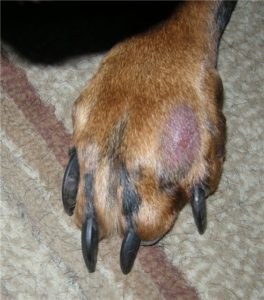
Swollen Paw in Dogs: Causes and Treatment
A lively and active pet sincerely rejoices in its owners, charging them with energy and positive emotions. That is why constant observation and inspection of your four-legged friend are so important. It is through this method that many dangerous diseases are most often prevented.
When a beloved pet, who was playful and jumping around just yesterday, suddenly becomes less active, start with a general inspection. Pay attention to their paws. It may turn out that the dog has a swollen pad or toe.
Causes of a Lump on the Paw
For an owner who notices that their dog has a swollen paw between the toes, it is necessary to conduct an inspection. The increase in paw size may be due to external factors:
- the dog was bitten by another dog. It is not necessary to interact with fighting breeds for this to happen. Your pet and the neighbor's dog could have been playing on the playground and accidentally injured each other.
- the pet may have landed awkwardly while jumping. If it is visible during inspection that the joint on the dog's paw is swollen, it is necessary to consult a veterinarian. It could be a dislocation or a fracture.
- the swelling is a result of an insect bite. Your four-legged friend may have simply stepped on a wasp or bee, which in turn stung it. Naturally, the dog's paw will swell after a bite.
- a splinter may have gotten into the pad on the paw or between the toes.
Analyzing the dog's behavior during walks or at home is usually enough to understand the cause of the paw injury. Besides external factors, there are natural reasons for paw swelling:
excessive accumulation of fluid in the body causes edema. Fluid is not removed in a timely manner or in the right amount due to internal problems, mostly related to the heart or kidneys.
prolonged strenuous activities, exhausting walks for the animal, also lead to swollen paws. An untrained dog finds it difficult to move a lot. Therefore, the workload should increase gradually. Elderly dogs are most often affected by this. Rest will help reduce swelling on the paws in this case.
Tip: Pay attention to the condition of your elderly dog during walks. If the pet wants to go home, end the walk.
if the dog's paws are red and swollen, it may be due to venous thrombosis. Due to thick blood, which has poor flow, the limbs swell. The animal finds it difficult to move in this condition.
a lack of protein in the dog's diet leads to a decrease in oncotic pressure in the body's biological fluids (blood, lymph, intra- and extracellular fluid). Introducing a sufficient amount of protein into the pet's diet automatically restores the pressure level.
if the dog's paw is swollen after surgery, it is necessary to immediately consult a veterinarian. The cause may be excessive strain or improper rehabilitation.
A dog owner whose dog has a severely swollen paw must be able to recognize the nature of the problem. Providing first aid will help the animal recover faster and return to an active life. If you cannot identify the cause of the swollen limbs, it is best to show your four-legged friend to a veterinarian.